
ICM unlocked - challenges to understand and overcome
Intentional Camera Movement (ICM) photography is one of the most expressive, and unpredictable, approaches to image-making.
Even with mindful consideration improving the likelihood of success, a number of challenges remain, ones that are specific to ICM and impossible to avoid.
In this article, I draw on my own experience to explore these challenges. While they cannot be eliminated, developing awareness and understanding can lead to better decision-making and more rewarding results.
Common Challenges
Pairing of subject & camera movement
This is something we’ve touched on before, but it’s worth exploring in greater depth. We’ve seen how following lines of contrast with the camera can help preserve a sense of form, while deliberately working against those lines can introduce tension and abstraction.
Choosing the right pairing of subject and camera movement remains one of the most persistent challenges in ICM - and one that should be embraced rather than avoided. There is no single correct approach, and certainly no fixed set of rules to follow.
Subjects with strong, well-defined structure - those clear lines of contrast - often lead to more predictable results. Yet it is frequently the more subtle subjects, combined with less obvious movements, that create images with greater depth and interest. This raises further questions: how do we approach subjects with multiple competing lines of contrast, or those with very little structure at all?
Developing an understanding of how form can be retained through movement is an essential foundation. However, as we move beyond these basics, the challenge shifts toward subject selection and, ultimately, artistic direction. It is within this space that a greater freedom of expression begins to emerge.
My recommendation is to first explore how camera movement and contrast interact in a variety of scenarios. From there, apply that understanding to subjects that are less straightforward and more open to interpretation. The key word here is exploration, learning as much from failure as from success.

Here the choice of movement was one to follow the flow of a receding wave, with an intent on capturing the character of the surf. Note how the strong line of the horizon has now become somewhat insignificant.
Delayed shutter response
When working with ICM, timing is not just important, it’s integral to the outcome. With the camera already in motion, understanding exactly when the sensor begins recording light becomes a critical part of the process.
There is often a small but meaningful delay between pressing the shutter release and the start of the exposure. For those using mirrorless cameras, this delay is typically minimal, with the shutter mechanism responding almost instantaneously. However, for DSLR users, this delay can be far more noticeable, as the mirror must first lift before the sensor is exposed to the scene in front of the lens.
In practice, this means the movement you intend to capture may not align perfectly with the moment you press the shutter.
My recommendation is to experiment at home and develop a feel for this delay. Observe how your camera responds and begin to anticipate that slight lag, adjusting your movement accordingly when shooting in the field.
Understanding how your equipment behaves helps to remove an element of guesswork from ICM, allowing your intent and execution to become more closely aligned.
Shutter speed selection
One of the greatest challenges in ICM is judging an appropriate shutter speed. That is one that allows the intended movement to be fully achieved, without extending beyond it. Alongside the speed of camera motion, this becomes a defining factor in shaping the final image.
Consider a simple example: a group of trees such as shown below. We may visualize the movement beginning and ending within a specific range, perhaps between the ends of the yellow lines. Ideally, the full exposure takes place within that space. If the shutter remains open beyond it, brighter areas of sky or snow could potentially overinfluence the result.

In this example we ideally want the shutter to open and close within the yellow lines.
Typically, selecting the right shutter speed relies heavily on experience, along with trial and error. While that approach remains valid, it is possible to reduce the uncertainty with a little preparation.
Step 1
As discussed previously, aim to keep your camera movement speed consistent. This alone removes a significant variable and begins to replace unpredictability with intent.
Step 2
The next step is to estimate a shutter speed that allows the camera to travel the desired distance during the exposure. This can be approached through simple visualization.
Before taking the shot, move the camera through the intended motion while looking through the viewfinder. At a consistent speed, observe the point where you would like the exposure to begin, and where you would like it to end. This “dry run” provides a sense of timing - how long the movement takes - and from that, a starting point for your shutter speed.
It is unlikely to be perfect at first, but with repetition, these estimations become more intuitive.
Trial and error will always have a place in ICM. But by introducing a process of visualisation, we begin to shift from reacting to results, toward shaping them and making outcomes more predictable.
Achieving an artistic level of blur
It is easy to assume that the goal of ICM is simply to introduce blur into an image. After all, movement naturally leads us there. But blur, in itself, is not the objective, it is only the byproduct. What we are really seeking is a quality of blur that complements the subject, what we may actually call artistic blur.
We have all seen ICM images that feel more accidental than intentional. I know that I myself have taken many that appear amateurish and simply stricken by a bad case of camera-shake. These are instances where blur is not working with the content, it is working against it.
A successful ICM image is simply not defined by how much blur it contains, but by how well that blur works with the subject. It should enhance form and contribute to the overall aesthetic of the frame. In some cases, this may mean retaining more structure than expected; in others, allowing the subject to drift closer to abstraction.
But how do we arrive at that balance?
While the quality of blur ultimately remains a matter of judgement, a practical approach is to treat any successful image taken in the field as a starting reference point. Once achieved, use that shutter speed as a baseline, then make small adjustments, capturing additional frames with slight variations.
The difference may seem minimal in the moment, but even subtle changes in shutter speed can significantly affect how motion relates to the subject. And because those differences may not be clear until you get in front of a PC, it is better to leave with more than you need. Returning with a range of variations offers choice and is far easier to take extra shots than to make a return trip to reshoot.
Key takeaway;
once you capture an image that works, shoot more using slight adjustments in shutter speed.
You’ll thank me when you see the results!



Each image above explores the character of Hosta foliage through different levels of blur. The final result is entirely personal; there is no right or wrong preference.
Pointed light sources
Pointed light sources are a frequent challenge in ICM photography, with the potential to make or break an image.
When I refer to these light sources, I include the obvious - the sun, as well as the various artificial lights that emerge as daylight fades. But there are also less obvious sources that are often overlooked: specular highlights or reflections, and even fragments of bright sky breaking through a forest canopy.

The reason these present a challenge is that, in ICM, these light sources manifest as streaks of light that mirror the movement of the camera.
That said, when understood and controlled, these same elements can be used to your advantage. Many photographers feel that light streaks bring a sense of energy or dynamism to an image, and some have even made them the primary subject of their work.
This is where understanding and control become critical. The photographer must recognize not only the presence of these light sources, but also how they will behave once translated through motion.
In the image to the left, I failed to account for the sun breaking through the clouds. Notice how the resulting streak follows the direction of camera movement, the intent of which was intended to trace the ridgeline of the distant mountains.

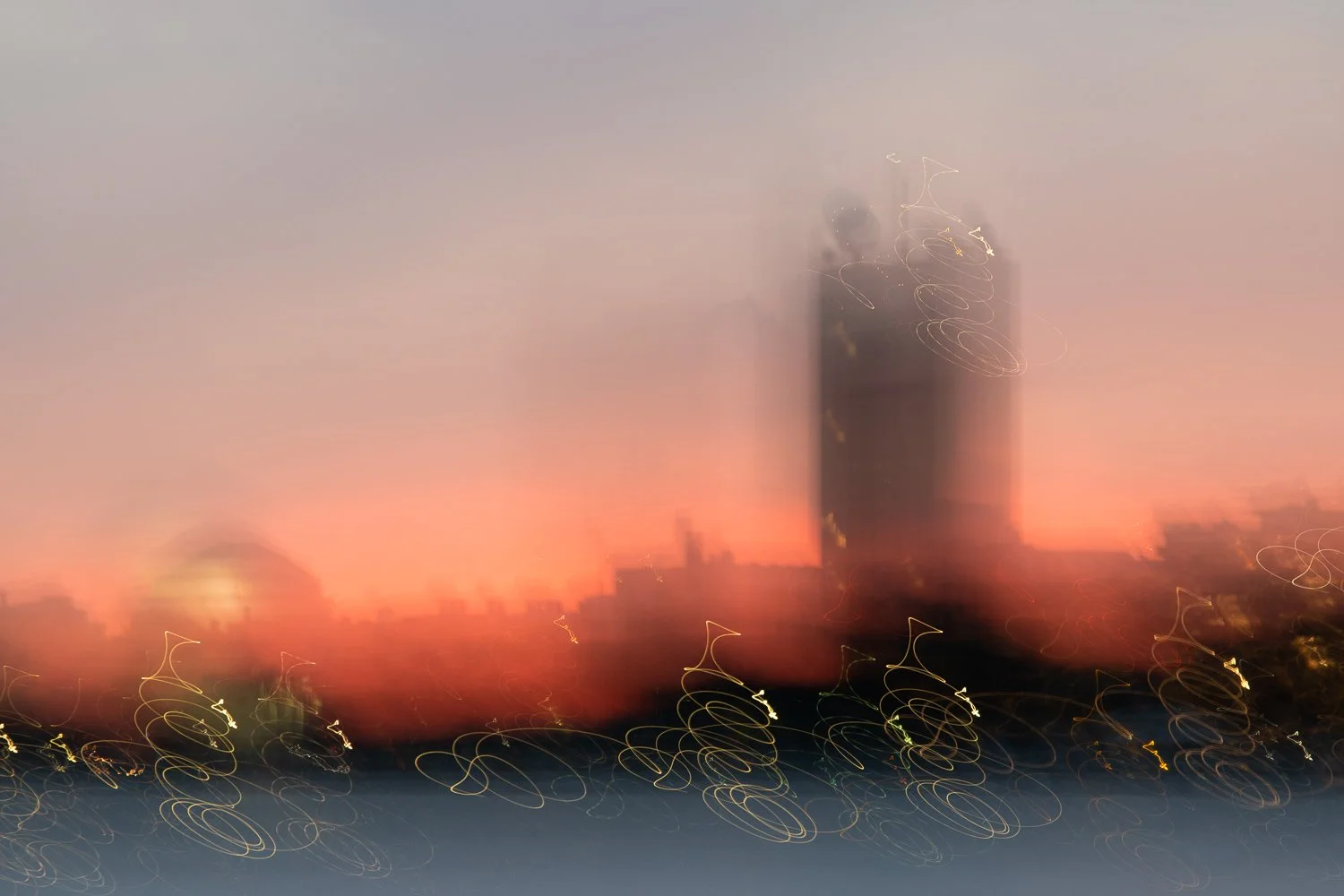
The images above reflect a progression in awareness. Both were taken at sunset: the first shows how evening lights can streak through an image without control, while the second applies that understanding - using camera movement more deliberately to position those streaks as foreground interest.
Final thoughts
The challenges in ICM are not obstacles we should expect to eliminate, but conditions to be understood and worked with. Rather than seeking certainty, the goal is to build awareness.
It is through this awareness that we create images that best reflect our understanding and creative intent.
These are some of the more major challenges I’ve encountered during my own journey - I'd love to hear about the challenges you’ve faced in yours.