
ICM unlocked - subject and movement selection
In my last article, we discussed what ICM (Intentional Camera Movement) is and briefly touched on its history and requirements.
In this post, we’ll explore how to get started with movement and look at classic ICM subjects. With this understanding, I’ll help guide you in deciding which types of movement best suit different subjects.
Core Movement
First, I’m going to introduce a term I use to describe this foundational ICM technique: Traditional ICM. This term best captures the style of ICM photography most people are familiar with, often characterized by the following:
The camera is in motion throughout the entire exposure. This means it is already moving when the shutter opens and does not stop until after it closes, resulting in a consistent level of blur across the image.
The camera often travels in a straight line. While this is not a rule, it frequently applies to classic ICM subjects - for reasons we’ll explore shortly.
Traditional Subjects
So now we have a camera in motion, with expected exposure times in excess of 1/10th of a second. This creates an ideal scenario for two of the most popular ICM subjects: upright trees and waterscapes.
The reason these subjects work so well lies in a critical concept:
Following lines of contrast with camera movement helps preserve form.
This simple idea forms a foundation for understanding ICM. It aids visualization and makes outcomes far more predictable.
This is best understood through example.
Waterscapes

Following the horizon - a strong line of contrast - helps maintain the overall sense of the image.
In this example, the camera motion follows the high-contrast line of the horizon. This is evident in the retained clarity of that line, as well as in elements within the water that echo the same structure.
The scene is immediately perceived as a sunset, largely due to the color palette. This demonstrates how following a dominant line of contrast helps preserve subject recognition.
But what happens if we choose not to follow lines of contrast? As might be expected, recognizable structure begins to break down.
In the following example, the camera is rotated during the exposure, transforming those lines of contrast into abstraction. This is a more advanced approach and is included here as a reference. Beginners will generally find more success by following lines of contrast to maintain a strong suggestion of the subject - while still allowing room for experimentation.
Ultimately, whether or not to follow lines of contrast is an artistic choice. There is no right or wrong, but doing so can provide greater predictability and early success.

Here, the camera motion contradicts the line of the horizon, resulting in a more abstract image. A greater reliance is now placed on the color palette that identifies the scene as a sunset.
Trees
Groups of trees are another core ICM subject. Here, camera movement typically follows the direction of growth to maintain a recognizable sense of form.
An important consideration when photographing trees is that the primary subjects should grow at a similar angle. Subject selection becomes key- trees that diverge significantly from the direction of camera movement will lose definition.
This can often be observed in background elements, where less uniform growth leads to reduced clarity.
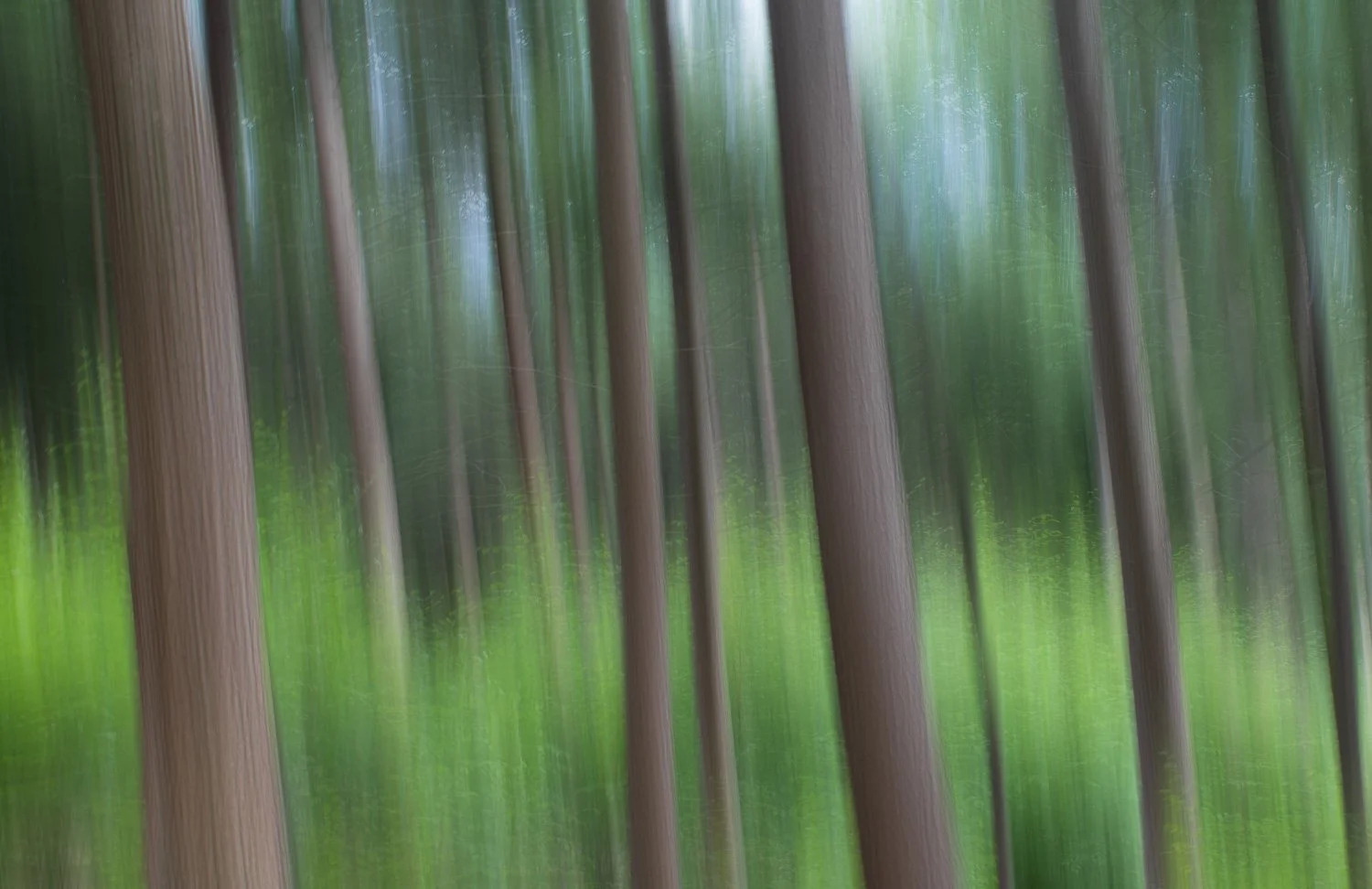
In this example, the trees grow in a uniform direction, helping maintain a consistent sense of form.
Other popular subjects
While waterscapes and trees are often the starting point, many other subjects work beautifully with ICM. This is not an exhaustive list - ICM has virtually no boundaries - but these are subjects and approaches that many find effective:
Landscapes
Landscapes remain popular due to their enduring appeal and wide range of possibilities. As detail gives way to suggestion, contrast becomes increasingly important.
When working with features such as rolling hills or mountains, I often use what I call “contoured ICM”—a movement that follows ridgelines or other natural lines of contrast within the scene.
Flowers
There’s something irresistible about creating impressionistic images of flowers.
For groups of flowers, smaller - often circular- movements can help maintain a sense of cohesion. For individual flowers, I typically choose a motion that follows the primary form.
When photographing a circular flower head-on, rotating the camera (again following the outer shape) can produce especially pleasing results.
Buildings/Architecture
These subjects benefit from strong vertical and horizontal lines. Movement following these structures often produce the most desirable results.
Human figures
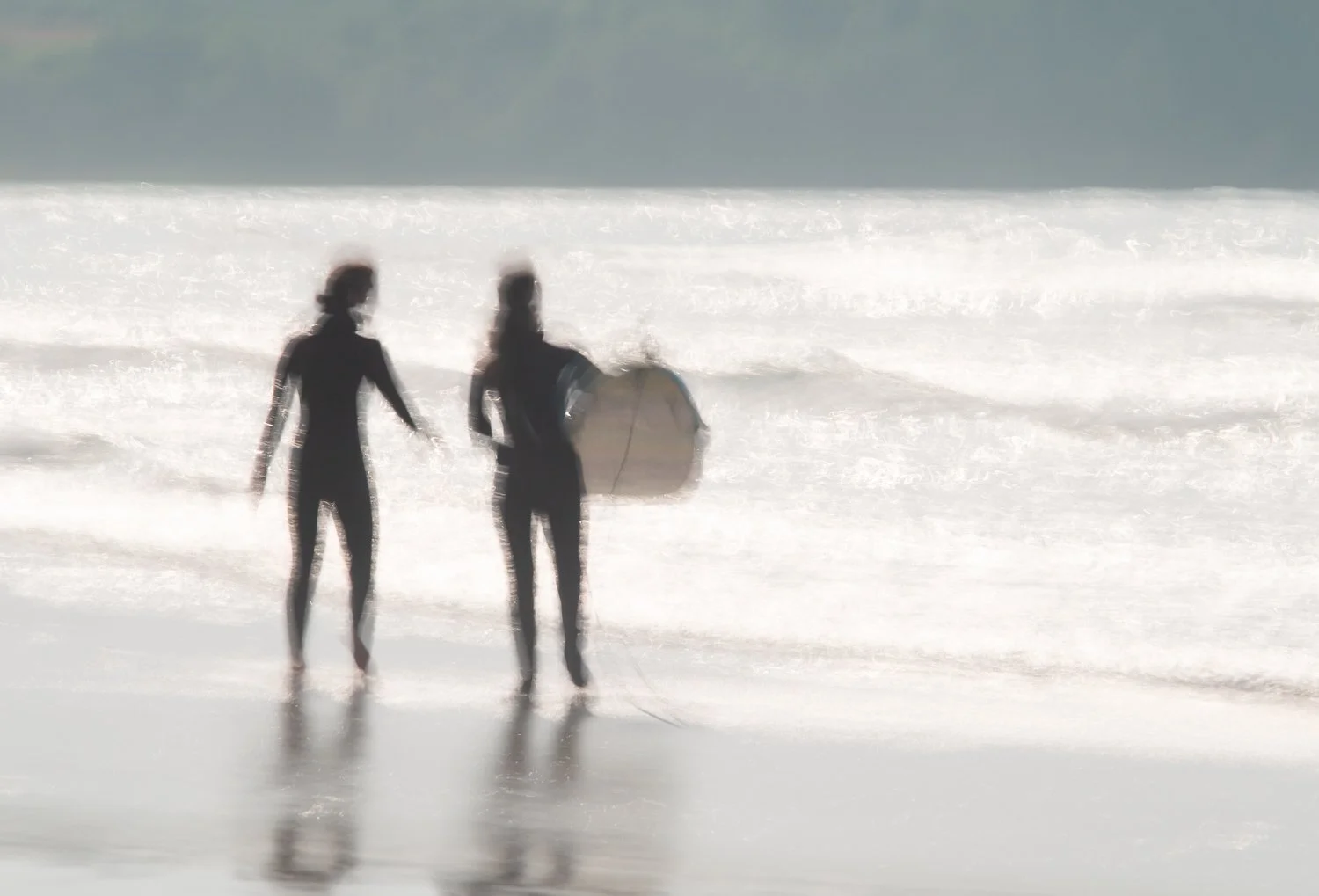
Without detail, gestures and visual cues become increasingly important in conveying the story.
Capturing the human form is one of my favorite pursuits. There is something rewarding about replacing detail with suggestion, capturing the mere essence of a person by gesture and presence.
Keep an eye out for associated props. Elements such as hats, umbrellas, and posture provide visual cues that help tell a story.
I’ve found the most effective approach is to follow the movement of the subject with the camera, even within groups, using a suitable exposure length (often in the 1–3 second range).
Camera Movements
Now that we have discussed the types of subject that are well-suited to ICM and touched upon motions that be matched let’s delve into the type of motions that may be used to create appealing results.
Linear
This is the straight line movement already discussed with trees and waterscapes, and perfectly matches subjects that contain strong linear lines of contrast. These can be buildings, plant life etc.
Contoured
Suggested in the earlier reference to shooting landscapes, what I term ‘contoured’ movement is simply an extension to the Linear motion above. Here, we are following lines of contrast (such as hilltops, plant foliage) which helps maintain a sense of form.
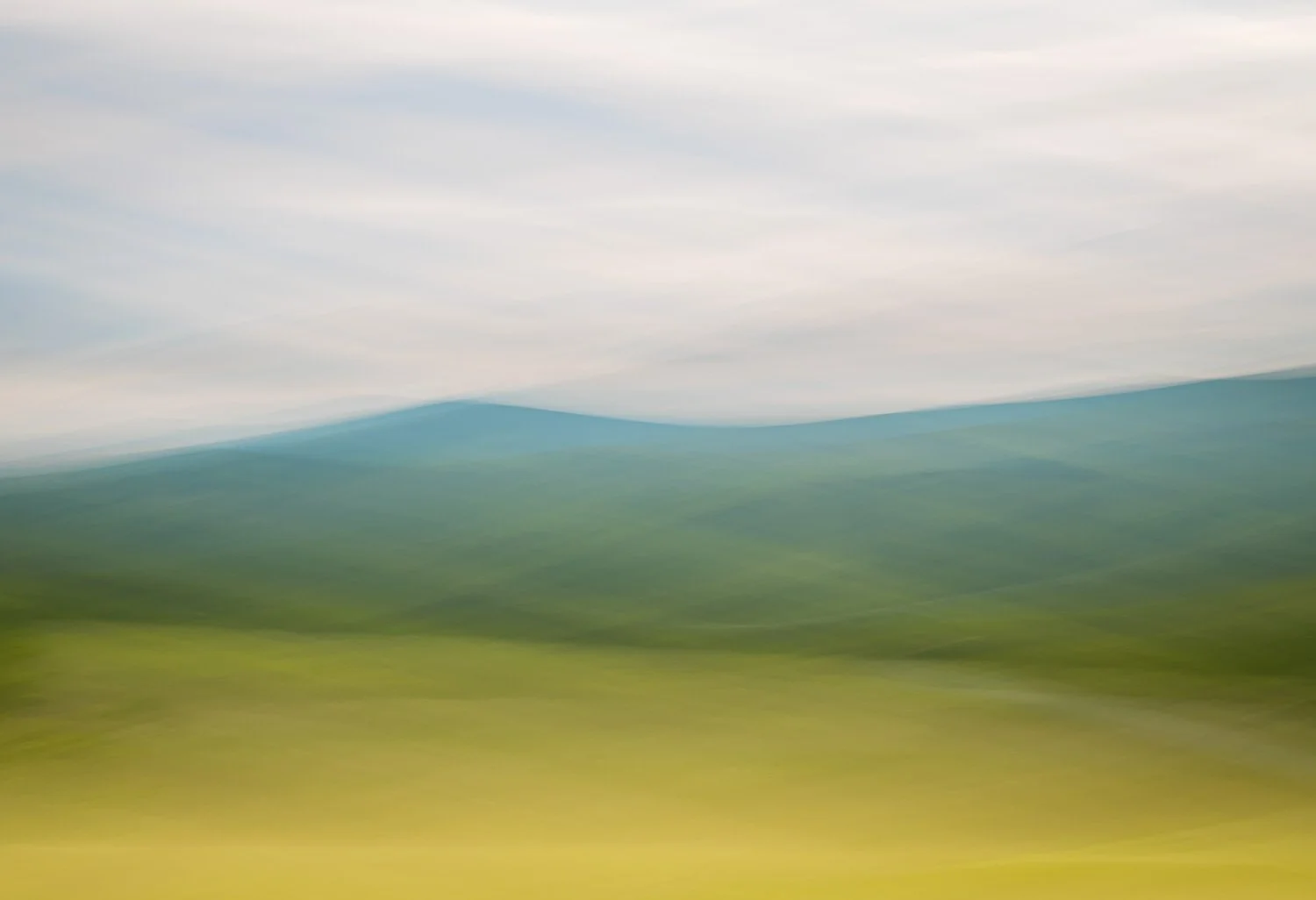
Following the ridgeline has helped maintain the outline of this sun-washed slope. Camera motion is reflected in mid-ground highlights and clouds
Jitter
Jitter is another term I have adopted to best describe an action (this may be descibed by others as ‘shudder’). In this case the camera is held firmly against the forehead, and with arms by the side the body forced into a shivering-like action. This results in small but rapid movement of the camera to provide more of a softening effect. This can be used in conjunction with other movements to vary the effect.
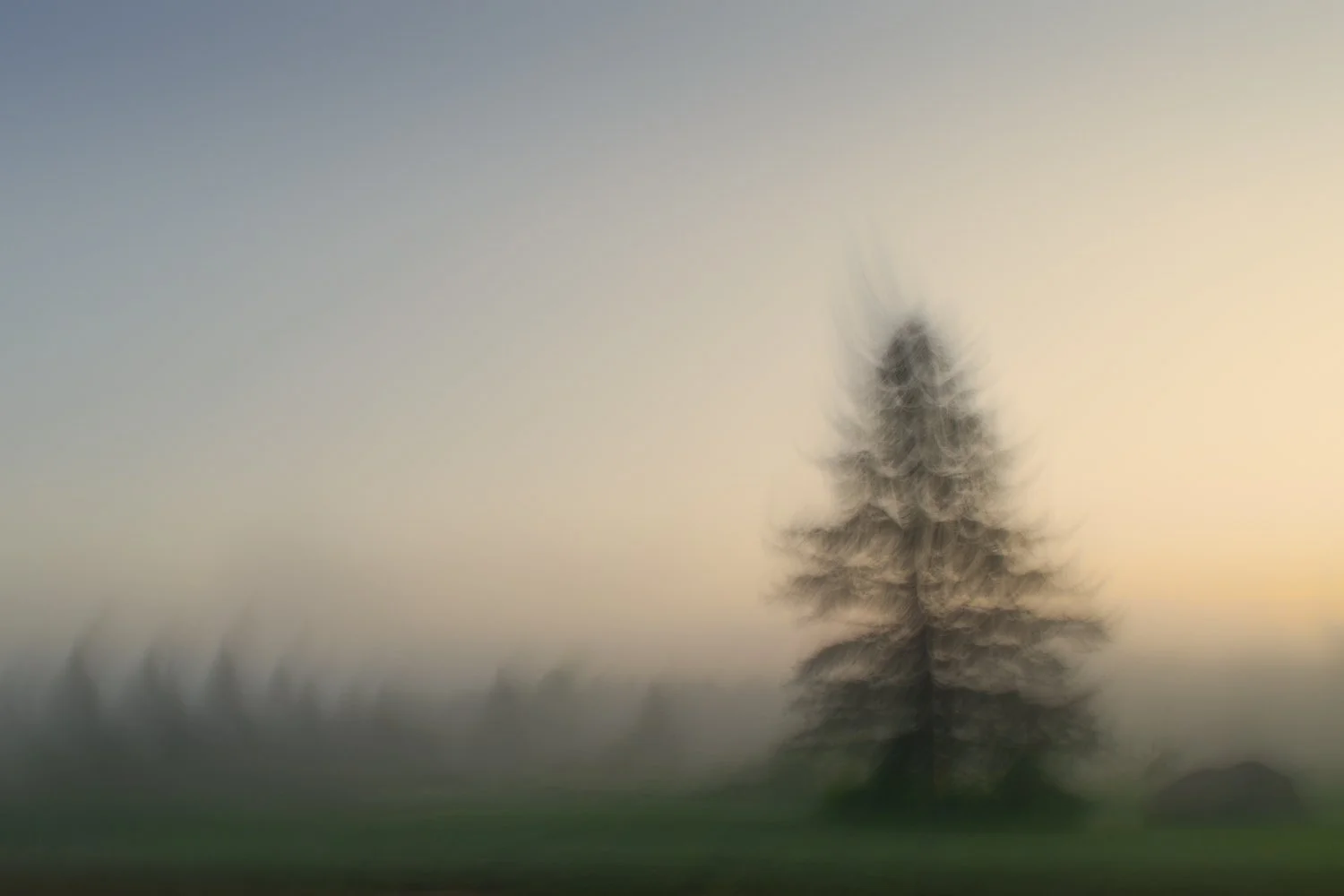
In this image of a foggy sunrise, a jittering motion was employed with the camera being panned down during exposure
Circular
Rotating the camera throughout an exposure creates a swirling effect to the resulting shot. This works best with smaller, less defined subjects such as groups of small flowers or to create more dramatic effects.
Zoom
Zooming the lens during a long exposure leads to a dramatic and instantly recognizable result. I find the most appealing outcomes come from a more subtle use of the technique, rather than allowing it to become the subject itself.
Holding onto the zoom ring of a lens whilst rotating the camera (a combination of these last two movements) will create a swirling zoom effect, which can be worth exploring.
These are the most common camera motions is use today, but exploration should be made to movements outside of this list. One motion that might be considered is one that is random. Many photographers have gained success be holding the camera at arm’s length and using the wrist to whip the camera during exposure. Results are often blended with a multiple of other random movements to build an appealing result.
Final thoughts
As you begin exploring ICM, remember that movement and subject are inseparable. Understanding how they interact is the key to moving from experimentation to intention.
Identifying potential subjects and matching with appropriate actions comes with experience, but this listing - although not exhaustive - should help flatten the learning curve. The main thing is to be armed with the knowledge that will help you find success, replacing randomness and luck with mindfulness and creation.